Say What You Mean & Mean What You Say: A Complete Therapist Guide to Assertive Communication
Action: Practice this guidance and dramatically improve your assertive communication skills.
Content: We'll cover tried-and-tested strategies to upgrade your daily interactions.
Results: An observable improvement in how others respond to you as well as demonstrably better responses to your requests. Personal and professional satisfaction along with enhanced self-perception.
Managing relationships with other people is complex. When inevitable friction arises, poor communication may compound the problem and generate more stress.
You want the other person to see and understand you. Yet, in heated moments, what you see as assertive may easily be misread as aggressive.
Misunderstandings lead to frustration, and then annoyance lights the fuse for overheated responses.
As a result, you risk saying the wrong thing or withdrawing and not saying anything at all. Either way, the possibility of taking or giving offence is a dissatisfying state of affairs.
Equally, you may shy away from expressing your feelings in heated situations.
Instead, you downplay the value of your thoughts and needs to avoid discomfort or protracted conflict. Yet this withdrawal feels like surrender, breeding frustration and self-disappointment because it isn’t who you want to be.
Let's move beyond this.
This article outlines how to communicate your needs, concerns, and frustrations.
It will show you how to express your position with a level head, an even temper, and a clarity of purpose. From minor daily interactions to work negotiations, let's upgrade your assertive communication skills.
Content:
- Why People Struggle to Assert Themselves
- Four Types of Communication
- Benefits of Assertive Communication
- Set-up for Success - Graded Exposure
- A LADDER to Get Started
- Importance of Body Language
- Assertive Complaining (without hurting feelings)
- Advanced Assertiveness Skills (to manage bothersome people)
How do you communicate - and why?
Assertiveness is a skill anyone can develop, yet many people find it difficult to put into practice. This isn’t a personal flaw — it’s often the result of early conditioning and the social environments we’ve lived in. Understanding these roots is essential if we want to replace old habits with more deliberate and confident ways of communicating.
Childhood Experience & Embedded Patterns
Our communication style often takes shape in early life. Two common early environments can undermine healthy assertiveness:
1) Volatile or blaming environments: In some households, adults are unpredictable — they may withdraw without explanation or erupt suddenly in anger. Criticism can arrive without warning, leaving the child unsure of what will set it off. Over time, the child learns to scan for danger and keep quiet about their own thoughts or needs, believing that self-silence is the safest way to avoid provoking conflict.
2) Anxious or conflict-averse environments: In other families, adults go out of their way to smooth over tension, placate others, or change the subject whenever disagreement arises. They may apologise quickly or avoid difficult topics altogether. The child absorbs the message that directness is risky and that maintaining harmony depends on compliance.
In both cases, the child suppresses their own needs. What begins as self-protection is often mistaken for maturity, but in adult life it can appear as over-compliance, emotional retreat, or difficulty setting boundaries.
These patterns are reinforced by emotional pattern-matching — the automatic linking of present situations to past experiences. A minor disagreement can trigger the old script, leading to withdrawal, mounting resentment, and sometimes a disproportionate outburst. The aftermath often brings guilt or shame, further entrenching the pattern and making change more difficult.

Social Expectations
Social and cultural norms can also discourage direct communication—especially in environments that prize conformity over candour. Some work settings, for example, reward passivity and punish dissent. Here, assertiveness may feel like a threat to the hierarchy and carry the risk of exclusion, rejection, or even job loss.
In such settings, silence becomes a form of self-protection. That said, if staying quiet is the only way to stay safe, it may be worth considering whether the environment itself has become unsustainable.
Four Types of Communication
Communication styles tend to fall into four broad categories: aggressive, passive, passive-aggressive, and assertive. While we may shift between them depending on the situation, one style usually feels most familiar. Understanding the impact of each can help you move toward a more balanced, assertive approach.
Aggressive communication involves expressing opinions, feelings, and needs in a way that overrides or dismisses those of others. The tone is often blunt, forceful, or impatient, which can make the message sound demanding or even hostile. Although the intention might be to get results, the effect is usually the opposite: people feel attacked, become defensive, and are less willing to cooperate. Outside of genuine emergencies, this style rarely leads to productive outcomes.
Passive communication is the opposite. Here, a person holds back their views, avoids stating needs, and defers to others’ preferences — especially those in positions of authority. This can feel safer in the moment, but over time it erodes a sense of agency. Important issues go unaddressed, decisions are made without your input, and the quiet frustration that follows can damage both confidence and relationships.
Passive-aggressive communication appears cooperative on the surface but contains a hidden edge of resentment. A person might agree to a request but deliver it with an irritated tone, use sarcasm to hint at dissatisfaction, or withhold full effort. This style can temporarily avoid open conflict, but it breeds mistrust and often escalates tension, as others sense the gap between words and intent.
Assertive communication is both direct and respectful. It involves stating your opinions, feelings, and needs clearly while also acknowledging those of others. The aim is mutual understanding rather than domination or avoidance. In practice, this means expressing yourself with sincerity, choosing words carefully, and keeping your tone measured. Done well, assertive communication builds trust, reduces misunderstandings, and leaves both parties clear about where they stand.

How Do You Communicate? Consider these questions:
What communication style do you default to? (aggressive, passive, passive-aggressive or assertive)?
- How does that tend to make you feel?
- Do you get the outcomes you desire?
- What would the benefits of assertive communication be?
We each use different communication styles for various situations. The form we adopt varies depending on who we're talking to. Yet, in most situations, a clear and transparent assertive style is generally the healthiest approach.
Assertiveness - Unrealistic Expectations
Often, without realising it, you might hold unrealistic beliefs about being assertive. This confusion deters you from becoming assertive.
It's helpful to remember:
You don't have to always agree with your friends to be a good friend (people usually prefer candour).
You don't have an obligation to agree with or say "Yes" to people.
You don't have to offer reasons or 'excuses' for saying "No".
Your needs are as important as other people's needs
Saying "No" to something means saying "Yes" to something else.
So, to be more assertive, you focus on what you say and how you say it.
Assertiveness - Setting Yourself Up for Success

Many people think of assertiveness as something you either have or you don’t. In reality, it’s a skill — and like any skill, it develops with practice. The challenge is that the leap from staying quiet to speaking up can feel too big to manage in one move. That’s where Graded Exposure comes in.
Become Assertive with Graded Exposure
Graded Exposure is a way of building confidence step by step. Instead of throwing yourself into the most intimidating situation straight away, you start with something small and manageable, then gradually work up to bigger challenges. For example, if your goal is to speak up in meetings, you might first practise expressing an opinion with a trusted friend, then make a short contribution in a small group, and only later address a full team.
Before each step, you take a moment to predict what you think will happen. Many people expect rejection, ridicule, or irritation from others — but in most cases, the reality is far less negative. By testing these predictions, you gather evidence that your fears are often exaggerated, and your confidence grows naturally.
The process works because each small success builds both competence and self-belief. You learn that you can tolerate the discomfort of speaking up, that it usually goes better than you imagined, and that any anxiety fades with repetition. The result is a steady expansion of your comfort zone, making assertiveness feel less like a risky leap and more like a familiar habit.
Graded Exposure provides a range of benefits:
- You practice incremental skills to build the desired assertive behaviour.
- You learn that your worries are usually inaccurate and unrealistic.
- Each step increases the challenge - and ups the reward.
By developing your assertiveness, you become more competent and less stressed. Thus you have more time and mental focus to invest in relationships, opportunities and enjoyable activities.
However, practising graded exposure tasks does involve some anxiety. But you will find that this anxiety settles with time and becomes less intense with repetition.
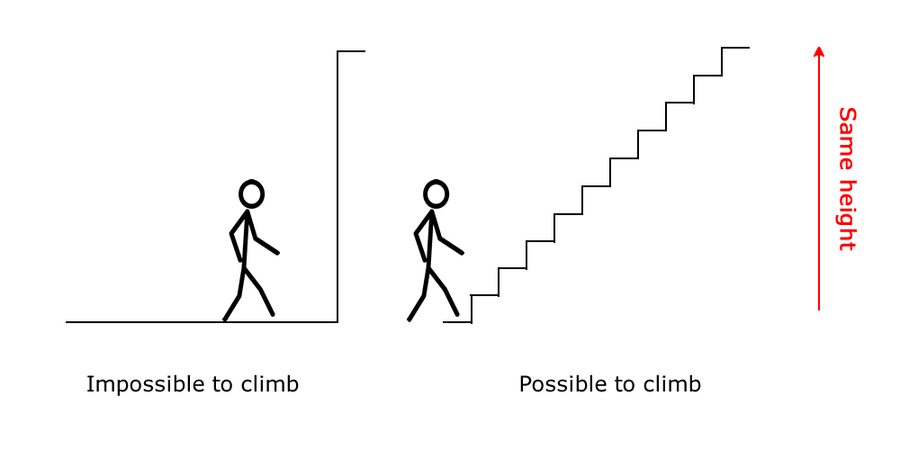
To chart and record your progress, I recommend creating an Exposure StepLadder (Download a FREE template at the end).
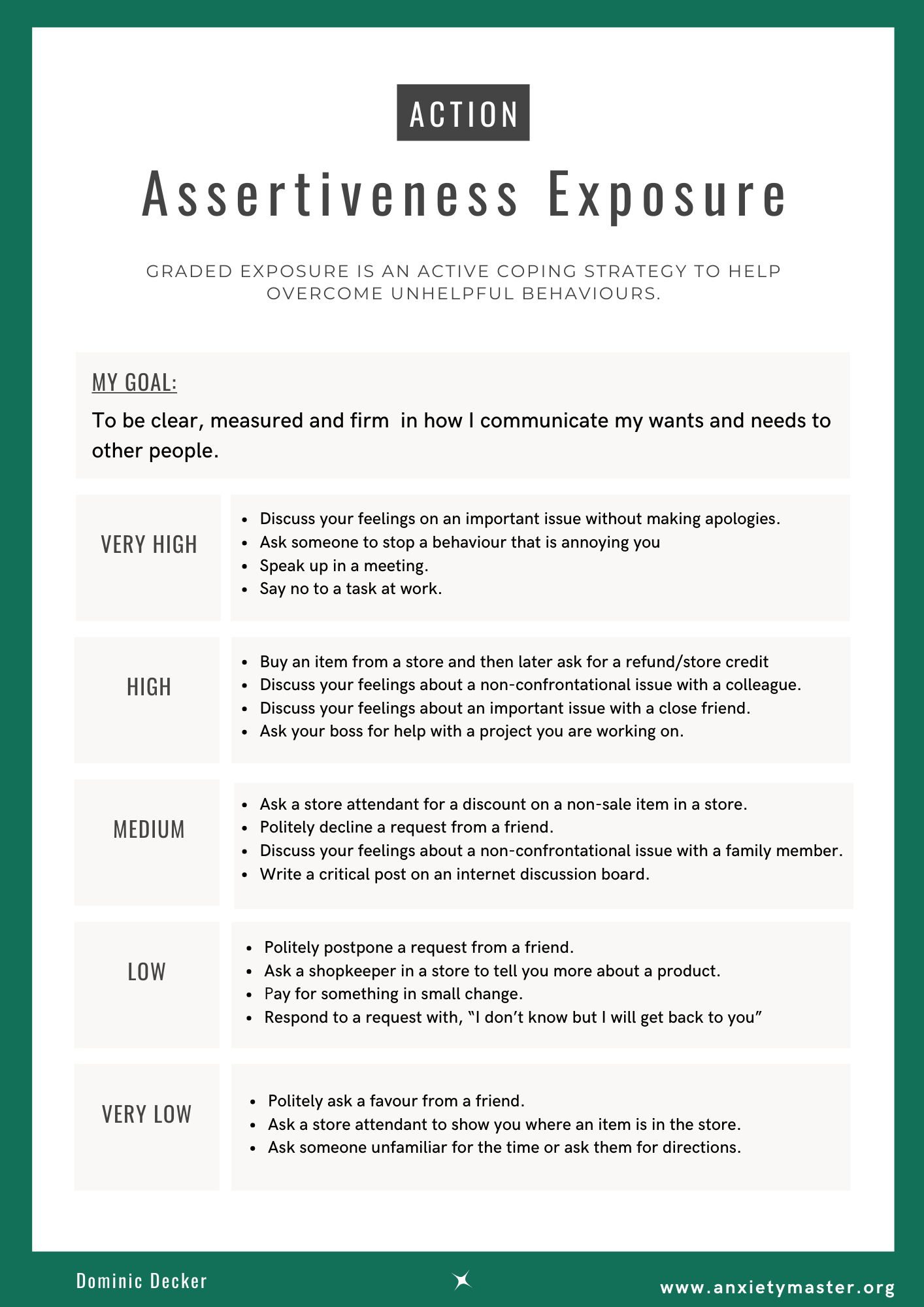
1. Clarify your goal (e.g. to express your wants and needs and to be less concerned with the response of others).
2. Rank your list of activities and situations associated with your goal (from low to high stress).
3. Pick a low-level (easy) task and practise it using the 'exposure' approach.
Assertive Communication: From Theory to Practice
If Graded Exposure is a strategy for cultivating assertiveness, we can use an Assertiveness LADDER to put this in to action.
Using an assertiveness ladder, you can plan and practice being more assertive. You can use the assertiveness ladder at home or at work. Use the letters of the word "LADDER" to recall the steps.
L: Look at your rights, what you want, and what you need. Define what you want, and keep it in mind during your discussion.
A: Arrange a time and place to discuss the situation. You can skip this step if the situation isn't planned, such as receiving the wrong food at a restaurant.
D: Define the problem for the other person. Don't assume the other person already knows about the problem.
D: Describe your feelings using "I" statements. An "I" statement tells how you feel without blaming someone else. For example, try saying, "I'm feeling frustrated," instead of "You frustrate me."
E: Express what you want or need. Be specific, brief, and firm. For example, instead of asking your partner to be "more considerate," ask him to call if he'll be more than 15 minutes late.
R: Reinforce the idea of getting what you want. Show the other person how your request might benefit both of you.
Non-verbal Communication
Of course, verbal communication is only one piece of the pie.
Some formulas estimate the interpretation of a spoken message is 7 per cent verbal, 38 per cent vocal and 55 per cent visual. If correct, this would place 93% of communication as "non-verbal".
Using assertive body language
Body language is how you sit, stand, move, and use your eyes and hands when speaking. Sometimes, you think you're being assertive, but your body presents a conflicting message.
That message can get in the way of what you are trying to say. Using the correct body language helps you communicate with greater confidence.
Keep these pointers in mind:
- Make eye contact with the person you're talking to. Try to keep your facial expression open and sincere.
- Sit or stand up tall with a straight back. Speak with a clear and firm tone.
- Use your hands and facial expressions to highlight your most important points.
- Try not to sound like you're asking a question when you're not. You'll recognize this when your intonation rises at the end of sentences.
- Don't use an apologetic tone of voice.
Practising your body language in front of a mirror can be helpful.

It's normal to feel anxious when you start practising assertive communication. This is why it can help to begin with an easy task first, for example, practising with a close friend.
Here's a simple three-step plan to practice and rehearse.
Assertive Complaining (Getting what you want without hurting someone's feelings)
When you complain, you want to feel:
- Heard.
- Understood.
- The matter can be put right.
However, you might avoid expressing your thoughts for fear of hurting the other person.
A good complaint should empower the other person to repair the situation. From this perspective, your complaint attempts to restore mutual trust and understanding. Let this be your guiding light.
So how do we do it?
Step 1: Start with ‘I’ and express the feeling.
‘I’m upset, worried, angry ...’
Step 2: Describe the situation and stick to the facts
‘I’m upset that I get interrupted when I talk.’
‘I’m disappointed that you didn’t come home like you said.’
‘I’m annoyed that I have to keep repeating myself.’
Describe yourself and the situation. Not the other partner.
Step 3: Express what’s needed
How can the other person make it better?
Make this clear and practical.
‘I need you to ...’
Your request should position the other person to repair and put things right.
Examples:
‘I’m upset that I get interrupted when I talk. I need you to let me finish speaking.’
‘I’m disappointed that you didn’t come home like you said. I need you to stick to our agreement.’
‘I’m annoyed that I have to keep repeating myself. I need you to listen to me carefully.’
Everything we've covered so far will offer you a clear passage through many situations.
Yet there are occasions when you need to go that step further to maintain calm and keep control.

Here you might want to reach into your bag for advanced assertiveness techniques.
I'm talking about persistent time-grabbers and obnoxious bigheads. Then there are bolshy types and unaware lane shifters with no sense of boundaries.
Let's uncover some techniques to manage these situations.
Advanced Assertiveness Skills - Managing Bothersome People Like A Boss
Some occasions make it particularly hard to be assertive. For instance, if the other person is being irrational or aggressive. In these situations, you may need to improve your skills further.
Fear not. Familiarise yourself with the following techniques to bring tricky situations back under control.
Be a broken record. This is useful for when someone persists in asking something inappropriate of you.
What to do: Repeat yourself over and over until the other person accepts your answer. Don't give explanations or excuses. Instead, offer the same response with the same measured tone.
Three times will usually do it, but don't be perturbed if it takes more.
Fogging.
The term fogging derives from the metaphor of a 'wall of fog'—absorbing arguments without reciprocating them.

Fogging is an effective strategy when faced with manipulative or aggressive behaviour.
Rather than counter-arguing, the technique delivers short and calm responses. These responses are conciliatory but not defensive. Your aim is to circumvent conceding to unreasonable demands.
Fogging involves acknowledging valid points in the other person's statements, even if critical.
If you refrain from adopting a defensive position, you've sidestepped the expected response. As a result, the aggressor often discontinues an aggressive approach.
This shift can pave the way for more rational discussion once tensions have subsided.
Example Situation:
"What time do you call this? You're nearly half an hour late. I'm fed up with you letting me down all the time."
Fogging Response: "You're right, I am later than planned, and I understand it's frustrating for you."
"Annoyed? Of course,I'm annoyed, and I've been waiting for ages. You really should try to think about other people a bit more."
Fogging Response: "I agree, waiting for someone can be irritating, especially for nearly thirty minutes."
"Well... why were you late?"
Positive Inquiry
Positive inquiry involves embracing praise and compliments.
People with lower self-esteem often find it challenging to accept positive remarks. They might feel unworthy or doubt the sincerity of the compliment. Yet a gracious response to genuine praise is to accept a gift from someone.
Positive inquiry involves delving into the praise and concurring with it.
Example Situation
Giver: "You made an excellent meal tonight; it was delicious!"
Receiver: "Thank you. I'm glad you enjoyed it. Could you tell me what it was that stood out for you?"
Contrast this with a passive dismissal, such as, "Oh, it was nothing," or "It was only a basic recipe.'
These responses serve to undervalue the effort and the compliment.
Negative Inquiry
Negative inquiry is a constructive method for addressing criticism or negative comments.
Rather than a defensive or hostile response, negative inquiry aims to understand criticism.
Example Situation
Sender: "That meal was inedible. I can't remember the last time I ate something so awful."
Receiver: "I see it wasn't to your liking. Could you specify precisely what you don’t like?"
This approach contrasts with aggressive retorts like, "How dare you criticise my cooking after all the effort I put in!" or "Fine, I won't bother cooking for you again." These responses only escalate the situation.
Remember, becoming assertive requires practice. Like any skill, you'll get better at it with repetition. There will be occasions when it doesn't work and other times when you'll be pleased with its effectiveness and success.
Don't expect to become assertive overnight. Instead, stay committed through regular practice. You'll see and experience the benefits, for sure.
Becoming Assertive: A Final Thought
Learning to express your thoughts, wants and needs is the greatest of gifts.
Whatever your current station in life, it's never too late to start practising the skills in the article.
As soon as you begin, you step into the light. From unseen to seen. Becoming assertive is an act of self-compassion. In standing up for your position, you extend the care that you offer others to yourself.
What's more, you'll attract supportive people and repel negative ones. You've got everything to gain, so get cracking. One. Step. At. A. Time : )
And remember:
Be who you are say what you mean, because those who mind don't matter and those who matter don't mind. Dr Seuss.
Don't Forget Your FREE Resource!
Join the Anxiety Master Community for immediate access to your blank Graded Exposure Ladder.